
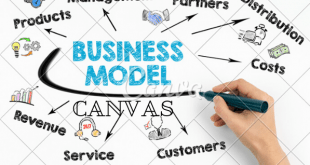
Business Model Canvas is a policy direction and a basic startup template for starting new or developing existing business. It is a visual outline with components portraying a company’s or item’s incentive, framework, clients, and finances. It helps firms in adjusting their exercises by showing potential exchange offs.
Business Model Canvas: The Art and Science of Commerce
If we make a list of some of the most iconic brands that exist today and chart their journey, we will see that most of them, if not all had a sine curve journey before crossing the threshold of sure success. The journey from the garage or apartment they started in, to the skyscraper building piercing the skyline was filled with ups and downs. Among many of the reasons for this was the lack of a singular plan that was tried and established as one for success.
Cut to the third decade of the 21st century and people have become smarter and more resourceful even at the beginning of their journey from venture to a multinational corporation. The Internet has given people access to treasures that were unthinkable even a few years ago. A person sitting at his home can now find out exactly what another person thousands of miles away wants, create it and send it with a guarantee of satisfaction. Four people at four corners of the world can come together and form a partnership without ever having met them in person. One can now use the wisdom of one hundred to create something at one goes by knowing how to avoid making the one thousand mistakes of those before him. Has there ever been a better time to be alive?
Business Model Canvas: Focusing large & Small Business
It is important to note a not-so-quiet shift in the focus of businesses, large and small. The product is no longer the focal point, the customer is. More specifically, it is the demand and acceptability of a product by people that is of greater concern to businesses. This means that often, businesses would create that demand artificially; giving people something “they never knew they needed.” This could even refer to a new revolutionary way of providing an already in-demand product to the consumers, simply by packaging and presenting it differently.
A good example would be, say Uber or Airbnb. They took an age-old concept, i.e., of common people renting out their cars or homes for a few days to earn the extra buck, and gave it a commercially viable twist. This would not have been possible without a foolproof business plan in place, that had researched the market and prospects well, knew where its resources would come from, and had affirmed its viability and scalability.
It is with this very goal in mind that business plans are created. They are meant to provide answers to the WH word questions for the business –
WHat, WHere, WHy, WHen, WHo and HoW.
Anyone who has ever been part of any business venture or expansion will know a business plan by the thick wad of pages that the boss slams on the table in front of you before the meeting. You feel a lot of feelings, dread and despair being the ones fighting for prominence. You can already feel the dull ache your wrist will get from furiously turning the pages to connect the dots between the different aspects laid out.
Benjamin Franklin, inspired by Confucius’ aphorism, had wisely said, “Tell me and I forget, teach me and I may remember, involve me and I learn.”
Perhaps from this very nugget of wisdom and from the necessity of simplifying a complex process arose the idea for the Business Model Canvas. Many of us know how the storyboard, born in the Hyperion studio of Walt Disney, completely turned around the process of creating a new story for a movie and is used by every movie maker today. Consider the business model canvas to be the storyboard for a business. Or the crazy wall used by detectives, without any of the “crazy” in it. And it will give you an idea of what the function of a business model canvas might be. Click Here For Start Up Business Loan
So what is the Business Model Canvas?
The idea for a visual tool to aid in strategic management and planning for the establishment of a start-up or branching of an old business to a new field was conceived back in 2004 by business model innovator Alexander Osterwalder as part of his PhD dissertation “The Business Model Ontology: A Proposition in A Design Science Approach.” In spite of publishing his model online through Slideshare and Blogspot, he wanted to make his innovation more easily accessible to everyone.
So, using crowdfunding, he published a business model canvas book along with his professor, information systems scientist Yves Pigneur on how to apply the business model canvas template for creating a game-changing business plan. It is called “Business Model Generation: A Handbook For Visionaries, Game Changers, And Challengers”. The book explains the 101 of the model, how to use it, business model designs and strategies along with numerous business model canvas examples.
There had been numerous business planning tools
Before the business model canvas came about, but what makes it unique is its visual and compact nature. In a one-on-one with Bill Fischer, Osterwalder had explained how he wanted business architects to be able to use the same facilities that actual architects use, i.e., having the whole blueprint of the plan on a single board for quick and easy visualization and evaluation. The model works so well because it puts every element of planning for a business on one page, which makes it much easier to make the necessary connections and draw the correct conclusions.
If you use an interactive platform, physical or virtual, you can actively involve all key decision-makers in the planning process. They can contribute their ideas and these can be incorporated in real-time. Moreover, you can also use the model to keep track of the ideas formulated from the results of the validated learning process in a lean start-up approach. No wonder businesses from the grassroots level to the sky-high level are quickly adopting the canvas.
Business Model Canvas Explained

The working theory of the business model canvas is that it takes every aspect of building a new business or improving and expanding an old one, and divides it into nine fundamental subheadings. These are represented as blocks in the business model canvas template. Each block is cleverly placed to make associations with each other more organic. If you look at the business model canvas sample below, you will see that the placement of the blocks follows a trend.
The right side deals with everything to do with the customers, including the revenue received as a result of them converting to your business. The left side deals with the businessmen themselves and their activities and expenditures. The two sides are tied in by the value proposition block in the middle, which can be thought of as the result of the left side and the cause of the right.
The 9 business model canvas blocks are explained below:
- Value Proposition –It defines the value you will be providing to the market. This does not simply imply the product or service you are going to deliver. It indicates the additional value you are adding to the market.
Thus, if you are a garment designer, it is not the clothes that will be your value proposition, since there are already enough clothes in the market. It is the innovation in the design or utility of your clothes that will be your value proposition. In simple words, the unique factor that will pull the customers in your niché is your value proposition.
- Customer Segments –This refers to the market niché you will be catering to. It breaks up the potential consumer base for your product into various segments based on different lifestyle and requirements to help you focus on the largest segment or segments and design the product accordingly.
- Channels –Every company has to decide which channel or channels they are going to get their product to the customers. The process starts right from marketing and lead generation to sale and customer support afterwards.
- Customer Relationships –Every company needs to maintain a continuous relationship with its customers and prospective. This is important to stay in their minds and prevent them from churning. The method of such association throughout the journey of the customer with the company must be chosen carefully to make purchasing the offered product easiest by that method.
- Key Resources –This lays down the primary resources a company needs to use to bring their value proposition to the market. This can be physical resources, human resources as well as infrastructure.
- Key activities –This block lists the main activities for the company to make implement its business model and make its value proposition a reality. This section will deal only with activities that specifically impact the value proposition.
Bringing back the old example, if our garment designer can produce his new design simply by delegating some of his old artisans to the job, he will only include setting up a supply chain and providing fresh space as his key activities, and not getting new staff.
- Key Partners –No business can stand alone. It needs suppliers, distributors, investors, and often other businesses to fill a gap they cannot. These relationships are mentioned in this part.
- Revenue Streams –Every company, before starting out, must specify beforehand the channels through which they expect the returns to come in. If the revenue streams are known, expenditures, activities and every other part can be aligned accordingly.
- Cost Structure –
 The cost structure spells out the expected expenditures and investments that the company needs to make to run the business.
| Offering | Customers | Infrastructure | Finances |
How to Use the Business Model Canvas
You can use the business model canvas online or offline. For a basic, no-frills platform to use the business model canvas template, Word or Google Docs can be used. As you work on the financial section at the bottom of the business model canvas template, Excel or Google Sheets can be used to keep an eye on the costs and expenditures, and estimate the viability of the venture.
You can also create a business model canvas presentation to use in a meeting. However, if you plan to involve your employees and managers in the planning, the business model canvas ppt must be used in the editing mode rather than the slide show mode. Once you have finalized your business plan in the business model canvas pdf version of the model can be created and printed out for use. Many a business model canvas app also exists to automate the process of creation, modification and evaluation of the business model canvas.
 truebusinessbd